

-

Welcome to the LTOA website
The London Tree Officers Association (LTOA) constitutes the professional & technical voice for London's trees & woodlands Read More -

Become a Sponsor
The LTOA relies on subscriptions from its members and sponsorship to operate. Read More -

CAVAT
Capital Asset Value for Amenity Trees (CAVAT). CAVAT provides a method for managing trees as public assets rather than liabilities Read More -

How to Become a Member
Members can attend, for free, the the LTOA meetings which are held four times a year and cover a wide range of tree related matters. Read More
- 1
- 2
- 3
- 4


The London Tree Officers Association
Welcome to the LTOA website. The London Tree Officers Association (LTOA) constitutes the professional & technical voice for London's trees & woodlands. Its aim is to enhance the management of the Capital's trees.
We hope that you find the LTOA website both interesting & informative. If you have any questions, comments or suggestions, please do not hesitate to contact us.
Come rain or shine: LTOA at the London Assembly Environment Committee
 In October 2014 the LTOA were invited to give evidence to the London Assembly Environment Committee in relation to a report about extreme weather events. We used the opportunity to highlight the fact that trees play a hugely important role in preparing London to cope with extreme weather events such as drought or flooding, and to make the point that whilst we are of course in favour of increased tree planting wherever possible, planting alone will not meet the targets to increase canopy cover so long as established trees are being removed. Essentially the message we tried to convey was that tree retention can be just as important as tree planting, even if it is not always so well reported.
The report has now been published, click here to view, and we are pleased to say that our comments have been included. On page 22 of Come rain or shine. London’s adaptation to the risks of severe weather (March 2015) it says:
“Trees have an important role to play. The Mayor has a target to increase London’s tree cover from a baseline of 20 per cent to 25 per cent by 2025 and 30 per cent by 2050; by 2025, he wishes for 2 million extra trees. The Mayor has several tree-planting programmes with targets of 10,000 to 20,000 trees each, which have so far led to the planting of more than 100,000 trees. Since this represents a relatively small proportion of the planned London-wide increase, progress will therefore have to be achieved mainly through other means.
New planting is only part of the solution. New trees take a long time to reach maturity and deliver their full benefits. Also in urban areas trees are often subject to removal or reduction for many reasons. A significant determinant of green infrastructure benefits in the short to medium term is the protection and well-being of existing trees and green spaces.”
The report also specifically sets out ten recommendations for the Mayor. Recommendation 6 is:
“The Mayor should demonstrate, with quantified contributions from different actions as in the Climate Change Mitigation and Energy Strategy, how and where his green infrastructure goals (including for tree cover and river restoration) will be met. Among the contributing actions will need to be better protection and enhancement of existing green infrastructure. The Mayor, with local government, should agree and implement appropriate measures to secure this.”
The LTOA are specifically referenced as the origin of the comment on page 22, demonstrating that our attendance at Committee had real influence. We hope that this document will be of use to our Membership as a further tool to be used in situations where trees are threatened, and we hope that the next Mayor of London will take on board Recommendation 6.
Richard Edwards, Chair of the LTOA, said "our reps rightly and successfully highlighted the need to manage and protect the Urban Forest we already have as well as planting for the future".
LTOA Seminar for LTOA members - Thursday 5 November 2015
Agenda
09:30am - Tea and coffee
10:00am - Welcome from LTOA chair and Executive Officer
10:10am - Sponsors of refreshments GreenBlue Urban
10:20am - David Archer Associates- new member introduction
10:25am - Southern Ecological Solutions SES - new member introduction
10:30am - The Big Tree Debate, Brita von Shoenaich, Bradley-Hole Schoenaich Landscape Architects
11:10am - Break
11:25am - From Dust to Dawn. Planting 90 Dawn Redwoods on the industrialised Edgware Road, Andy Tipping, LB Barnet
11:45pm - Growing semi mature trees for successful landscaping projects, James Hillier, Hillier Nurseries
12:00pm - Large growing species for urban situations, Tom Wilson, Barcham Trees
12:15pm - Felling licence exemptions, Andy Glover, Forestry Commission
12:30pm - Questions
13:00pm - Lunch sponsored by GreenBlue Urban
Thanks and notes
Thank you to Clare Pappalardo at LB Haringey for arranging the venue and GreenBlue Urban for the refreshments.
Arboriculture and Forestry Announce New Apprenticeship Standards
Government approval has today been granted to two brand new Trailblazer apprenticeship standards which are set to benefit employers in the forestry and arboriculture sector.
The Arborist and Forest Operative apprenticeship standards were developed over the past 12 months through a comprehensive consultation and hundreds of hours of input from over 40 organisations, encompassing the full spectrum of the industries involved. They have now been approved at Westminster and lead the way in the government’s drive for apprenticeship reform in England.
Trailblazer apprenticeships are led by employers for employers and aim to ensure apprenticeships are tailored to the needs of industry. The standards list the key skills, knowledge and behaviours apprentices should achieve in order to complete their apprenticeship.
Apprenticeship programmes, based on these standards, will give employers the confidence that their apprentices will develop the skills they need to make meaningful contribution to their company.
Timothy Leavers of Euroforest Limited commented ‘The dual pathway forest operative standard provides specific training in the two main forestry disciplines of establishment and harvesting, allowing an employer to tailor their training to the company’s core business, and provide a clear focus for the apprentice.’
Simon Rotheram of Beechwood Trees and Landscapes Ltd added ‘We are pleased to see that the time and effort put in by a number of companies and individuals is coming to fruition, this hard work has formed an apprenticeship for arboriculture that will provide individuals with the training necessary to make them a useful asset to the industry and their employers...exciting times for the development of budding arborists are ahead.’
The final two standards, Horticulture & Landscape Operative plus Horticulture and Landscape Supervisor have recently been submitted into the government approvals process.
The next stage of the process has already commenced and assessment plans are being written for each occupation. These are employers’ opportunity to explain how to test the apprentice’s expertise. Draft plans were shared with 40 training and assessment providers during a meeting at the end of September. The valuable insights from this meeting will be discussed by the industries involved over the next two months and plans devised accordingly. It is hoped that delivery of the new apprenticeships will begin in the middle of next year.
Ash Dieback
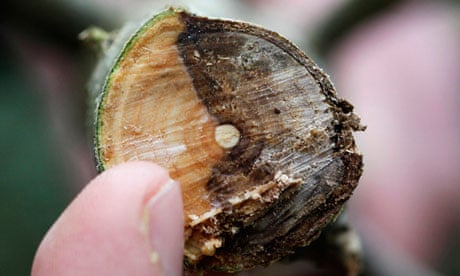
On 21st September I attended a presentation organized by the FC at Bedgebury Pinetum from Iben Margrete Thomsen from University of Copenhagen titled “Ash Dieback: a forest threat with limited impact in urban areas and the open landscape.”
One of the most informative presentations on Ash Dieback I have been to. It was a presentation of 2 halves, the first concentrated on plantations and woodlands and the Foresters view point.
There is no doubt Chalara is bad news for foresters; it leaves trees open to secondary infection from things such as honey fungus, stops incremental growth in its tracks and quickly reduces the timber value so that it useless for all except fire wood. Even worse, the natural regeneration and young plantings die rapidly from Chalara infections, and thus the future ash forests are lost.
Iben M. Thompson states:
"Our rules of thumb are that ash below age 10 dies whether in forests or outside, only Chalara needed. Ash up to age 40 dies rapidly in forests (Chalara and Armillaria combined), fairly often in the landscape (depending on site conditions, but still slower and in smaller numbers than in forests) and occasionally in urban environments (already stressed trees). Older ash deteriorate quite fast in forests (older and larger trees slowest), occasionally in landscape and urban settings. This applies once the disease is established and widespread, like I’ve seen in some areas of Kent during my visit. And of course trees with partial resistance will last longest, and after about ten years of severe impact the non-susceptible trees will stand out".
"It’s a disaster in forests but less fatal in towns and the open landscape" reports Iben M. Thomsen. She explains that in towns and cities leaf litter is removed more often than not, dryer conditions means fewer fruiting bodies and suboptimal infection conditions, less risk of basal infection, and no secondary damage agents such as honey fungus or ash bark beetles.
Iben M. Thomsen pointed out that for urban and road side ash trees it is mainly young ash trees which are affected and may die, the older ash trees may deteriorate with occasional death but it can take years for the trees to die. But she also showed us examples of completely unaffected ash trees in Copenhagen.
It is also worth remembering that just because an ash is dying back it may well have nothing to do with Chalara. Iben Margrete Thomsen has investigated many cases of ash dying where the cause was not only linked to Chalara. However, ash trees stressed by other factors will be hit harder by the disease, which may become the final straw, since it kills the most vital parts of the crown.
A good tip was that young ash trees show Chalara dieback symptoms first, if it is not in the young trees it will not be in the old either, so inspect the younger trees first. Another point is that the dieback fluctuates, so trees may look sick one year and healthy next year when new shoots have filled out the crown.
A strong message from the presentation is don't fell to soon.
"Preserve ash trees in cities and along roads and in the landscape for as long as possible, keeping safety in mind."
It is worthwhile pruning out dead branches rather than felling and only remove trees when the tree is either dead, dangerous (eg due to honey fungus in the roots) or no longer of value in the landscape.
So what of the future for ash, she encourages using resilient species such as F. ornus and F. americana. Hopefully, non-susceptible clones of F. excelsior will become available in the future.
For me what I took away is that it is not all doom and gloom as was reported a couple of years ago in the popular press. Not all our ash trees are going to die, we should not panic and should manage and maintain our ash in exactly the same way as we have been doing for years just like any tree, inspect, carry out remedial works and when the time comes which could be many years down the road, remove them when they become hazardous.
Don’t make the mistake as some in Demark did and removed their ash tree too early and are now thinking I wish we had not been so quick to fell.
Iben Margrete Thomsen has kindly provided her presentation that can be found here and I hope that we can organise for her to present at one of our LTOA seminars.


