

-

Welcome to the LTOA website
The London Tree Officers Association (LTOA) constitutes the professional & technical voice for London's trees & woodlands Read More -

Become a Sponsor
The LTOA relies on subscriptions from its members and sponsorship to operate. Read More -

CAVAT
Capital Asset Value for Amenity Trees (CAVAT). CAVAT provides a method for managing trees as public assets rather than liabilities Read More -

How to Become a Member
Members can attend, for free, the the LTOA meetings which are held four times a year and cover a wide range of tree related matters. Read More
- 1
- 2
- 3
- 4


The London Tree Officers Association
Welcome to the LTOA website. The London Tree Officers Association (LTOA) constitutes the professional & technical voice for London's trees & woodlands. Its aim is to enhance the management of the Capital's trees.
We hope that you find the LTOA website both interesting & informative. If you have any questions, comments or suggestions, please do not hesitate to contact us.
Managing Chalara ash dieback in London
 This leaflet provides some practical advice on managing Chalara’s impacts on biodiversity and the landscape, protecting economic returns from timber production, safeguarding the public, compliance with legislation, identifying trees which show resistance to the disease, and increasing the resilience of our woodlands.
It focuses on how we manage the decline of ash in the landscape and woodlands, and is intended for use by local and highway authorities, private tree and woodland owners, and tree-care contractors.
Ben Morris, Senior Arboricultural and Woodlands Officer, LB Sutton explains how a man was hit with an £8,000 bill and criminal record for pruning trees so his pool would catch the sun
The incident happened over 12 months ago in February 2014. A call came into the Parks department saying a resident was removing Council owned trees. My colleagues at the time attended (as I was on leave) and confronted the house owner; they then called the local park police. The police attended and arrested the house owner. The duty Sergeant then unarrested them. It was only when we pushed the police that they the charged the house owner again.
A few weeks later, I was asked to have a look at the trees again with regard to their value, as some of the trees had been so badly hacked, I made the assumption that they had full canopies prior to the event. The trees have started to regenerate but obviously lost their central leader, so as stated in court, their value was reduced. I was very conservative when calculating their value, this proved to be a good thing in court, as they could see I had not over egged the cake so to speak.
The defence had an expert witness - who concentrated mainly on the condition of a large Ash tree which had been reduced back in 2009. They also brought into the mix poor planning that allowed the property to be built in 2011, far too close to this tree to which I agreed, but was not my issue. There was a Daldinia growing on an old stump on the lower stem but this was irrelevant to the case, as was the Council’s inspection records which were also questioned. It has really highlighted to me the importance of a good and well recorded management system which we now have in place. Prior to this on an open site, such as allotments, we had risk assessments only.
At the beginning of the trial the defence Expert and I got together to produce a joint statement which helped the process and stopped a lot unnecessary hassle during the trial. The Judge was quite good at steering the barristers in getting to the real issue of criminal damage, rather that swaying the jury with misleading information on inspection schedules etc.
The defence was focused on the structural condition of the Ash and that the householder was concerned about the safety of his family - he said there was a hanging branch which he cleared; something that I said would have been dealt with by our term contractor on an emergency basis. It was obvious that there was far more removed than just a hanging branch. It was also pointed out that the accused used unskilled staff with no safety equipment which put them, him and others at high risk of harm.
In the dock, I was asked about the type of debris and why I believed that more than two branches had been remove from the large Ash. There was also question why we thought all the trees had been damaged at a similar time, freshness of cuts, poor quality, all done in haste etc
In the end it was a unanimous decision by the Jury which was a surprise. The whole thing was quite stressful at times, but a good experience. The lessons I will take away from this are improvements in recorded inspections and more time and detail in producing reports, when investigating criminal damage.
London Tree and Woodland Awards
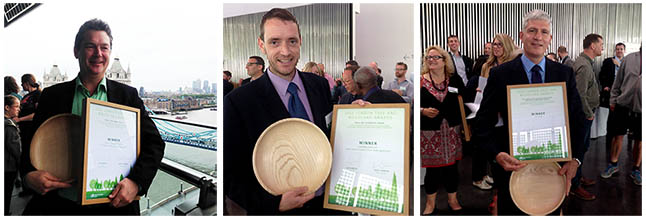
On the 27th May 2015, London City Hall hosted a celebratory awards event to celebrate the work of individuals, communities and professionals to protect, improve and expand the capital’s tree and woodland cover.
Roger Evans (Deputy Mayor) and Ian Gambles (Forestry Commission England Director) attended the event and congratulated everyone in London for their hard work.
 |
||
| Andy Tipping with the London Borough of Barnet award | Jonathan Robinson with his Trees & Technology award | Jim Smith with his LTOA Individual Commitment award |
LTOA members who won an award were:
Street Tree 2008-2015 Award:
London Borough of Barnet - A5 Edgware Road tree planting project.
The A5 Edgware Road tree planting project in Barnet involved the planting of 89 Dawn redwoods trees along a very busy road, having a transformative impact on the local environment and expected economic regeneration benefits.
The Trees and Technology Award:
Jonathan Robinson for his development of the Open Source Canopy Cover Audit application
For developing this innovative software in his own time. It is very simple and effective for users, to help understand the amount of canopy cover over a chosen area.
The London Tree Officers Association Individual Commitment Award:
Jim Smith
The LTOA Executive Committee awarded Jim for the years of hard work promoting Trees in London and for championing the important works that tree officers undertake.
Confirmed finding of oriental chestnut gall wasp
The tree pest oriental chestnut gall wasp (Dryocosmus kuriphilus) has been confirmed in sweet chestnut trees (Castanea sativa) in a woodland in Kent.
Statement:
A Forestry Commission spokesperson said:
“The oriental chestnut gall wasp has been discovered in one area of Kent.
“This is a pest that only affects sweet chestnut (Castanea) species of tree, and does not pose any risk to people, pets or farm livestock.
“We have launched an immediate investigation of the surrounding woodland and, once we have fully assessed the situation, we will swiftly take any appropriate action.”
Key facts:
- Oriental chestnut gall wasp is a pest that affects species of sweet chestnut tree. Only European sweet chestnut (Castanea sativa) is grown in significant numbers in Britain, and no other tree species in Britain is affected.
- The Forestry Commission is undertaking a full survey and analysis to determine the scale of the current outbreak and the potential cause of the outbreak.
- Once we have fully assessed the situation, we will swiftly take any appropriate action.
- Oriental chestnut gall wasp is a threat to sweet chestnuts in several regions of the world. It reduces nut production and can weaken the tree, leaving it vulnerable to other diseases.
- The UK has Protected Zone Status against this pest, and the plant health services must be notified of all pending imports of sweet chestnut planting material before its arrival in the UK so that a proportion can be inspected.
- As part of investigations into the outbreak, the new Observatree group of trained volunteers have agreed to help survey more widely for evidence of the pest.
A full statement has been published on our website at www.forestry.gov.uk/gallwasp, and will be updated as the situation evolves. The affected woodland is Farningham Woods, near Sevenoaks, Kent.
FURTHER INFORMATION
The website should answer most questions you might have, but:
- forestry media enquiries can be directed to Charlton Clark in the Forestry Commission England press office onThis email address is being protected from spambots. You need JavaScript enabled to view it.; tel 0300 067 5049;
- woodland owners and managers needing further information may contact Forestry Commission England’s tree health team onThis email address is being protected from spambots. You need JavaScript enabled to view it.; tel 0300 067 4000.


